Beyond the Ramp: Putting the Postal Plan to the Doorstep Test
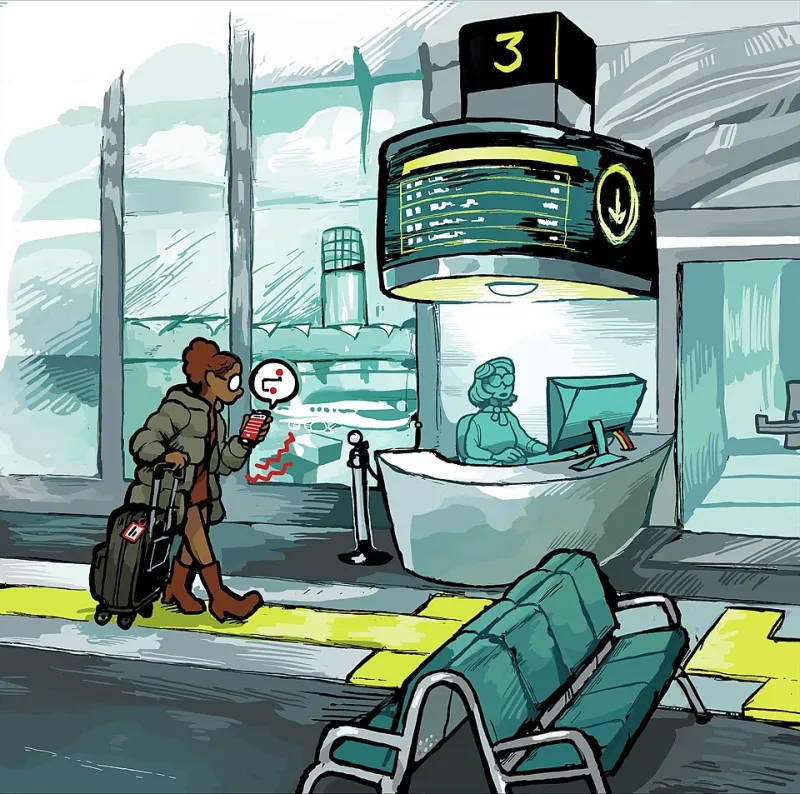
Photo: Sherm for Disabled And Here, CC BY 4.0, via Wikimedia Commons
Postal change is rarely experienced as a diagram. It is experienced at the door, at the bus stop, at the counter and at the point where a letter in an accessible format fails to arrive. For blind, partially sighted and disabled customers, proposals affecting access points, delivery frequency and counter services are not abstract questions about network design. They determine whether mail can be read, collected, understood and challenged.
The commitment and the journey
Royal Mail and Ofcom both speak the language of accessibility. Published commitments commonly refer to alternative formats, staff assistance and reasonable adjustments. Those commitments matter. But a commitment on a website is not the same as a braille letter arriving on time, a large-print bill being delivered to the right address, or a member of staff being available to help at an access point that is actually open.
The test for 2026 should therefore be practical. Can a customer who cannot read standard print receive correspondence in the format they need? Can a partially sighted customer navigate to an access point independently? Is assistance available without a pre-booked appointment? If a delivery office or local post office closes, who explains the alternative in an accessible way, and how far in advance?
What changes at the counter
Counter services are often treated as a residual part of the network. For many disabled customers they are the human interface with the postal system. Staff assistance may be needed to complete forms, identify parcels, use a signature device or understand a charge. An access point in a convenience shop may be perfectly adequate for some customers and wholly inadequate for others if the counter is high, the lighting is poor, the queue is unstructured or no member of staff is trained to assist.
The loss of a local post office or delivery office can therefore be more than a change of address. It can add a journey, a reliance on public transport, a need to arrange support and a loss of privacy. For customers who manage their affairs through the post, those are service changes in their own right.
The large print test
Campaigners can apply a simple but searching test to any planned change. First, ask whether the information about the change has been provided in accessible formats, including large print, braille, audio and easy-read where appropriate. Second, ask whether the alternative access point is reachable independently and whether the route is step-free. Third, ask what assistance is guaranteed on site and by whom. Fourth, ask how complaints and missed deliveries will be recorded and monitored for disabled customers. Fifth, ask what happens when something goes wrong.
These questions are not adversarial. They are the minimum evidence needed to judge whether an accessibility commitment has operational meaning. A plan that works only for customers who can read a standard notice, travel easily and use a counter without help has not passed the test.
Questions to put to Royal Mail and Ofcom
In 2026, campaigners and MPs should press for clear answers on the record. Has an equality impact assessment been published for each access point or delivery office change, and does it consider disabled customers specifically? How will alternative formats be protected if delivery arrangements change? What is the guaranteed standard of staff assistance at access points, and how is it audited? How are closures and service changes communicated in accessible formats and with what notice? What data does Royal Mail collect on complaints, failed deliveries and access difficulties experienced by disabled customers? How does Ofcom assess whether those arrangements meet universal service obligations, and what redress is available when they do not?
Constituents can help by documenting their own journeys: the date of a missed accessible-format delivery, the distance to an alternative access point, the absence of staff assistance, the cost of a taxi or the missed appointment that followed. Casework evidence is more useful than anecdote when it is specific, dated and shared with consent.
A service standard, not an afterthought
Accessibility is sometimes treated as a specialist concern to be addressed once the main network decisions have been taken. That sequence is the problem. If disabled customers are considered only after access points have been selected and delivery patterns fixed, the adjustments available are limited to explanation and apology. The better approach is to test the plan against real journeys before changes are confirmed.
The postal service is a public service, and its accessibility should be measured at the doorstep. Campaigners do not need to oppose every change to insist that change is tested properly. They need to ask whether the new arrangement works for the customer who cannot see the notice, cannot stand in the queue or cannot make the journey. That is the doorstep test, and it should be applied in 2026 with the same rigour as any financial case.