After the Shutters Come Down: Following the Mail, the Workers and the Waiting Times Through a Delivery Office Merger
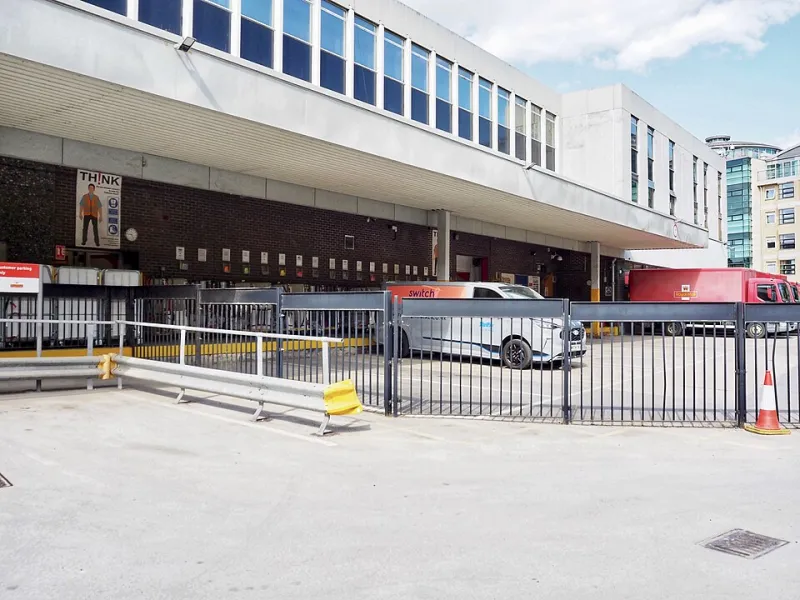
Photo: Malcolmxl5, CC0, via Wikimedia Commons
The notice usually appears without much ceremony: a laminated sheet in the window of a delivery office, a short paragraph on a local authority planning portal, a line in a trade publication. Royal Mail is reviewing its network. A site is to be consolidated into a larger hub. Customers are assured that services will be maintained, that there will be no reduction in the quality of delivery, and that the change will allow investment in newer, more efficient facilities.
Then the shutters come down, and the questions begin. Where does the mail actually go? Who sorts it? Who delivers it, and from where? And why does the first delivery of the morning start arriving at half past eleven?
Three different buildings, often confused
Public discussion of postal closures tends to blur three distinct kinds of site, which is one reason the arguments so often talk past one another.
A mail centre is a large sorting facility, handling mail for a wide region. A delivery office is where posties report for duty, collect their mail, prepare their walks and return at the end of the day. It is the building with the vans outside at seven in the morning. An access point is a post office branch or a parcel locker or counter where customers hand items over.
Consolidation usually means closing a delivery office and moving its work to another, larger delivery office or a combined site some distance away. The access point may remain open. The post office counter may remain open. What changes is the distance between the mail and the person who walks it out.
What happens to your letter
In a consolidated arrangement, mail that would once have been sorted overnight at a local office is instead handled at the hub. It is sorted there, then trunked — driven — back out to the area it serves, where a postie either collects it from a satellite point or begins the walk from the hub itself.
The consequence is time. A round that once began at 7am with mail sorted in the same building may now begin later, because the mail has to travel. Delivery offices that have been through this process commonly report first deliveries shifting from the early morning to late morning, and in some rural cases into the afternoon. The last collection times for posted items can move earlier for the same reason, in reverse.
For most households this is an inconvenience. For small businesses dispatching orders, for people waiting on hospital appointments, benefit letters or legal correspondence, and for anyone who relies on the post arriving before they leave for work, it is rather more than that.
What we hear from affected areas
Save Our Royal Mail has spoken with residents and postal workers in several areas that have been through consolidation. The details differ; the shape of the account does not.
In a Lincolnshire market town, the delivery office was moved to a hub roughly eighteen miles away. Residents reported that first deliveries shifted from before 9am to between 11am and 1pm within a few months, and that the local sorting office building was subsequently advertised for redevelopment. Postal workers described longer unpaid travel at the start and end of shifts.
On the North Norfolk coast, where the population swells sharply in summer, the concern was seasonal capacity. A hub serving several towns struggles to absorb holiday volumes that were previously handled locally, and agency staff unfamiliar with the area take longer to complete rounds.
In a South Wales valley community, the change came with staff transfers rather than compulsory redundancies. Within two years, several experienced posties had left, and newer staff were covering rounds they had not grown up on — a loss of the accumulated local knowledge that makes an awkward rural walk work in bad weather.
These accounts are not, on their own, proof of a national pattern. They are consistent with one, and they are the reason residents in other areas are right to ask questions early.
The workforce arithmetic
Consolidation is rarely presented as a staffing change, but it is one. Rounds are revised. Travel time between the hub and the first delivery point has to be found from somewhere, and it is usually found from the working day. Staff who cannot reasonably travel to the new site leave, and are replaced by staff who can. The office loses the person who knew which gate sticks in winter and which dog is loose on the lane.
None of this appears in a consultation document that speaks only of buildings, vehicle movements and improved facilities. It should.
Warning signs to watch for locally
- Language such as "network review", "efficiency review", "modernisation" or "estate optimisation" applied to a named delivery office.
- A consultation window of a few weeks, with a public meeting held in a library on a weekday afternoon.
- Recruitment advertisements for delivery staff in your area that name a different town as the base.
- Changes to last collection times on local postboxes, announced quietly and without explanation.
- Rounds being "revised", with posties suddenly covering unfamiliar streets.
- The delivery office site appearing in property listings, or a planning application for change of use.
- An announcement of a new parcel hub, described as an investment, without any statement about the offices it will absorb.
Questions worth putting in writing
Anyone responding to a consultation should ask, and ask for answers in writing:
- What is the average and maximum distance a postal worker will travel between the new site and the start of their round?
- What is the projected change in the time of the first delivery, by postcode sector?
- Will last collection times change, and by how much?
- How many staff will transfer, and how many are expected to leave?
- What is the plan for peak periods, and how many agency staff will be used?
- How will undelivered or mis-sorted items be returned, and from where?
- What consultation was held with affected staff and their representatives, and when?
- What will happen to the vacated site?
Note that Royal Mail is not subject to the Freedom of Information Act, so documentary requests are unlikely to yield much. Your MP can table a written parliamentary question, and your local authority's planning committee can require information as part of any application affecting the site. Both routes are worth using.
Keeping a record
If your delivery office is under review, start a simple log now: the time of your first delivery each day, any missed deliveries, any changes to collection times, and the dates of any public notices. A month of dated entries is far more persuasive to a consultation panel, a councillor or a journalist than a general impression that things have got worse.
The people who run these changes rely on the fact that most of us notice late. Noticing early is not opposition for its own sake; it is the minimum required to make a consultation mean anything at all.